How Misrii Meal Box Is Intelligently designed for your health + Budget in Jaipur?
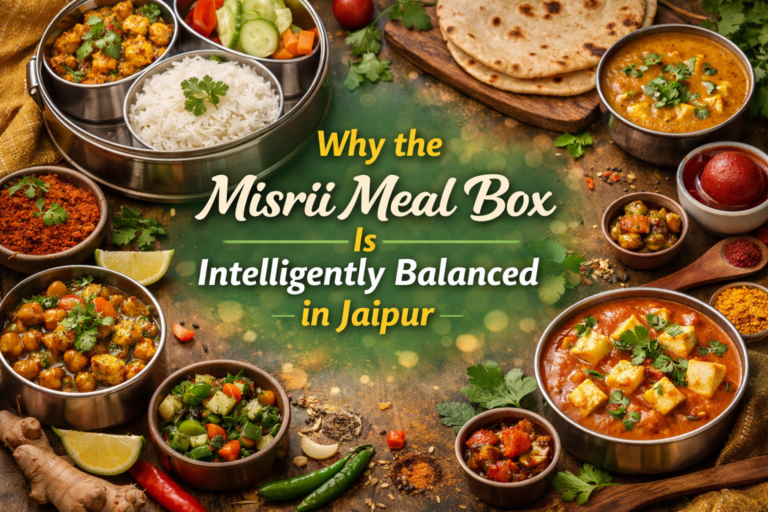
A Research-Backed Look at Home-Style Balanced Meals in Jaipur
In today’s fast urban life, many people in Jaipur search for:
- healthy meal delivery
- home-style food in Jaipur
- balanced tiffin service
- light daily lunch options
But what actually makes a meal balanced?
At Misrii, balance is not marketing language.
It is designed — drawing from modern nutrition research and classical Indian food intelligence.
What Modern Nutrition Research Says About Balanced Meals
According to the Harvard T.H. Chan School of Public Health – Healthy Eating Plate model, a balanced meal should contain:
- ½ plate vegetables and fruits
- ¼ whole grains
- ¼ healthy proteins
- Healthy oils in moderation
(Source: Harvard School of Public Health, The Healthy Eating Plate, 2011–updated guidelines)
Similarly, the World Health Organization (WHO) recommends:
- Limiting free sugars
- Reducing saturated fats
- Avoiding trans fats
- Increasing dietary fiber intake
(Source: WHO Healthy Diet Fact Sheet, 2023 update)
The Indian Council of Medical Research (ICMR) – National Institute of Nutrition (NIN) 2020–2024 dietary guidelines emphasize:
- Seasonal, locally sourced foods
- Controlled oil intake
- Balanced macronutrients
- Home-prepared meals over ultra-processed foods
These are not trends.
They are globally validated principles.
The Problem With Modern Convenience Food
Recent global studies (BMJ 2019; Lancet Commission on Diet 2020) link ultra-processed foods with:
- Increased inflammation
- Higher obesity risk
- Metabolic disorders
- Energy crashes
Many commercially prepared foods often rely on:
- Reheated gravies
- Refined vegetable oils
- High sodium
- Excess oil for taste retention
While satisfying in the moment, such meals may disrupt digestion and blood sugar stability.
Ayurveda’s Perspective: The Science of Agni
Long before nutrition science formalized macronutrients, Ayurveda emphasized:
- Freshly cooked, warm meals
- Balanced rasa (taste profile)
- Seasonal eating
- Digestive spices like jeera, haldi, hing
- Moderate oil use
The concept of Agni (digestive fire) is central to Ayurvedic dietary philosophy.
Modern research on the gut-brain axis now confirms that digestion plays a critical role in:
- Immunity
- Mood regulation
- Metabolic stability
(Source: Harvard Medical School, The Gut-Brain Connection, 2021)
Ancient knowledge and modern science are not opposites.
They often converge.
How the Misrii Meal Box Aligns With These Principles
Misrii meal boxes are structured around:
- Controlled portions
- Seasonal vegetables
- Dal or protein component
- Measured use of cold-pressed oils or cow ghee
- Balanced spice profile aiding digestion
- Fresh daily preparation (not mass reheated stock)
This aligns with:
✔ Harvard’s balanced plate model
✔ WHO dietary moderation guidelines
✔ ICMR’s Indian dietary recommendations
✔ Ayurvedic digestive balance principles
It is not designed for occasional indulgence.
It is designed for daily consumption.
Why Structured Meals Matter for Urban Professionals
Research shows that balanced meals:
- Stabilize blood glucose
- Improve sustained energy
- Reduce post-lunch fatigue
- Support metabolic health
(Source: Harvard Health Publishing; ICMR Dietary Guidelines)
For working professionals in Jaipur, this translates into:
- Better productivity
- Lighter digestion
- Reduced evening lethargy
Balanced food is not about luxury.
It is about operational efficiency — inside the body.
Home-Style Food in Jaipur: The Bigger Context
In cities like Jaipur, increasing dependence on restaurant-style food has shifted dietary patterns.
ICMR data highlights rising concerns around:
- Excess oil consumption
- Refined carbohydrate intake
- Reduced fiber diversity
Returning to structured, home-style meals restores balance without extreme dieting.
That is the philosophy Misrii quietly follows.
Final Thought
A truly balanced meal does not announce itself.
It feels: Light. Sufficient. Sustainable.
The Misrii meal box is built on structured nourishment — supported by global research and rooted in Indian food intelligence. Because everyday food should support life — not disrupt it.
Swadishtam. Sampoornam. Anandam.
Because food deserves thought.
